
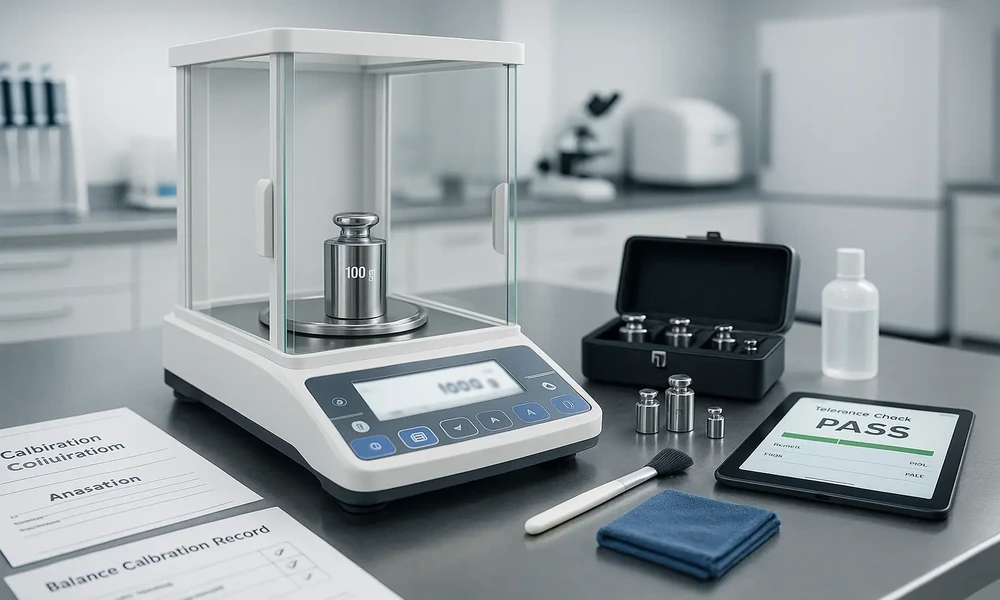
Almost every quantitative result in a laboratory begins with a weighing. A standard solution, a sample for assay, a reagent for a titration: if the mass is wrong at the start, every calculation after it carries the same error. That is why a lab analytical balance deserves more attention than its quiet presence on the bench suggests.
Analytical balances are built to read tiny masses, commonly to 0.1 mg and in some semi-micro models to 0.01 mg. At that resolution, small changes in temperature, air movement or even the position of the instrument can shift the result. Calibration is how a lab proves that the figure on the display matches the true mass.
What Is Involved in Calibrating an Analytical Balance?
People often use “calibration” and “adjustment” as if they meant the same thing, but they are different steps. Calibration means comparing the balance reading against reference weights of known mass and recording the difference. Adjustment means correcting the balance so that its reading moves closer to the reference value.
Calibrating analytical balance equipment formally usually involves checking several points: sensitivity at or near full capacity, linearity across the weighing range, repeatability from repeated weighings of the same weight, and eccentricity, which tests whether the reading changes when the load sits off-centre on the pan. A calibration certificate records the results along with the measurement uncertainty.
Many modern instruments include an internal adjustment weight that the balance applies automatically, either on a schedule or when it detects a temperature change. That feature is helpful, but it does not replace periodic checks with external reference weights, because the internal weight itself can drift.
Which Calibration Weights Should a Laboratory Analytical Balance Use?
Reference weights are classified under the international recommendation OIML R 111, which sets accuracy classes from E1, the finest, through E2, F1, F2 and down to the M classes used for coarser scales. The general rule is that a test weight should be accurate enough not to add meaningful error to the check, which in practice means choosing a class finer than the instrument you are testing.
For a laboratory analytical balance reading to 0.1 mg, fine classes such as E2 or F1 are commonly used, depending on the capacity and the tolerance the lab needs. Semi-micro and micro balances generally call for E2 or even E1 weights.
The weights themselves need care. Handle them only with tweezers or gloves, since fingerprints add mass. Keep them in their fitted case, let them reach room temperature before use, and have them recalibrated at intervals so their own certificates stay traceable to national standards.
How Often Should a Digital Balance for Laboratory Use Be Checked?
There is no single interval that suits every lab, and the right frequency depends on how critical the weighing is, how heavily the instrument is used and what your quality system demands.
A common approach combines three layers. A quick routine check with one or two weights before use or at the start of each day confirms nothing has gone badly wrong. Periodic internal tests, perhaps weekly or monthly, look at repeatability and eccentricity in more detail. A full external calibration by an accredited provider, often once a year, gives the documented, traceable record that auditors look for. In India, labs working under ISO/IEC 17025 typically use calibration providers accredited by NABL.
A digital balance for laboratory work should also be checked after it has been moved, serviced, dropped or exposed to a sudden change in conditions. Weighing should stop immediately if a routine check falls outside its tolerance.
What Environmental Factors Throw Off Balance Readings?
At four or five decimal places, the room itself becomes part of the measurement. The usual culprits are:
- Air draughts from doors, air conditioning vents or people walking past.
- Temperature changes, including samples placed on the pan while still warm.
- Vibration from centrifuges, pumps or a busy corridor.
- Static charge on plastic containers or dry powders.
- Magnetic fields and rising heat from nearby equipment.
Place the balance on a solid, vibration-damping weighing table, away from windows and vents. Close the draught shield doors before reading. Level the instrument using its bubble indicator every time it is moved, and allow it to warm up after switching on, as many manufacturers recommend leaving it powered so the electronics stay stable.
Magnetic stirrers deserve a particular mention because they so often share bench space with the balance in teaching and QC labs. The trouble is not limited to a stirrer that is running: a stir bar left inside a beaker, or a retriever rod resting beside the pan, can pull on the weighing mechanism enough to shift the final digits. Take stir bars out before weighing, keep magnetic tools away from the balance, and if readings creep for no obvious reason, check what else nearby contains a magnet.
What Happens When a Balance Goes Out of Calibration?
The consequences reach well beyond one wrong number. In a pharmaceutical or food testing lab, an error in weighing a reference standard flows into every sample calculated against it. Batches can be released or rejected on false data. In research, results that cannot be reproduced waste months of work.
Regulators and auditors treat weighing records seriously for this reason. If a balance is found to be out of tolerance, the lab may need to investigate every result produced since its last successful check, which is why sensible check intervals and good records save so much trouble.
How Can Weighing Technique Support a Calibrated Balance?
Calibration confirms the instrument is sound, but technique decides whether each weighing is accurate. Use the smallest suitable container, tare it carefully, and add the sample with a clean spatula. Let samples reach room temperature before weighing. Read the result only after the stability indicator appears. Know the minimum weight for your instrument, since weighing amounts below it gives a relative error that may be too large for your method.
What Makes a Balance Calibration Programme Reliable Over Time?
A reliable programme rests on traceable reference weights of a suitable OIML class, a written schedule of routine and full checks, and records that show who checked what and when. Pair that with a stable, draught-free location and careful technique, and the balance becomes something the whole lab can trust. Every result built on a weighing starts from that trust, so the effort spent on calibration pays back in fewer repeats, fewer investigations and data that stand up to scrutiny.
